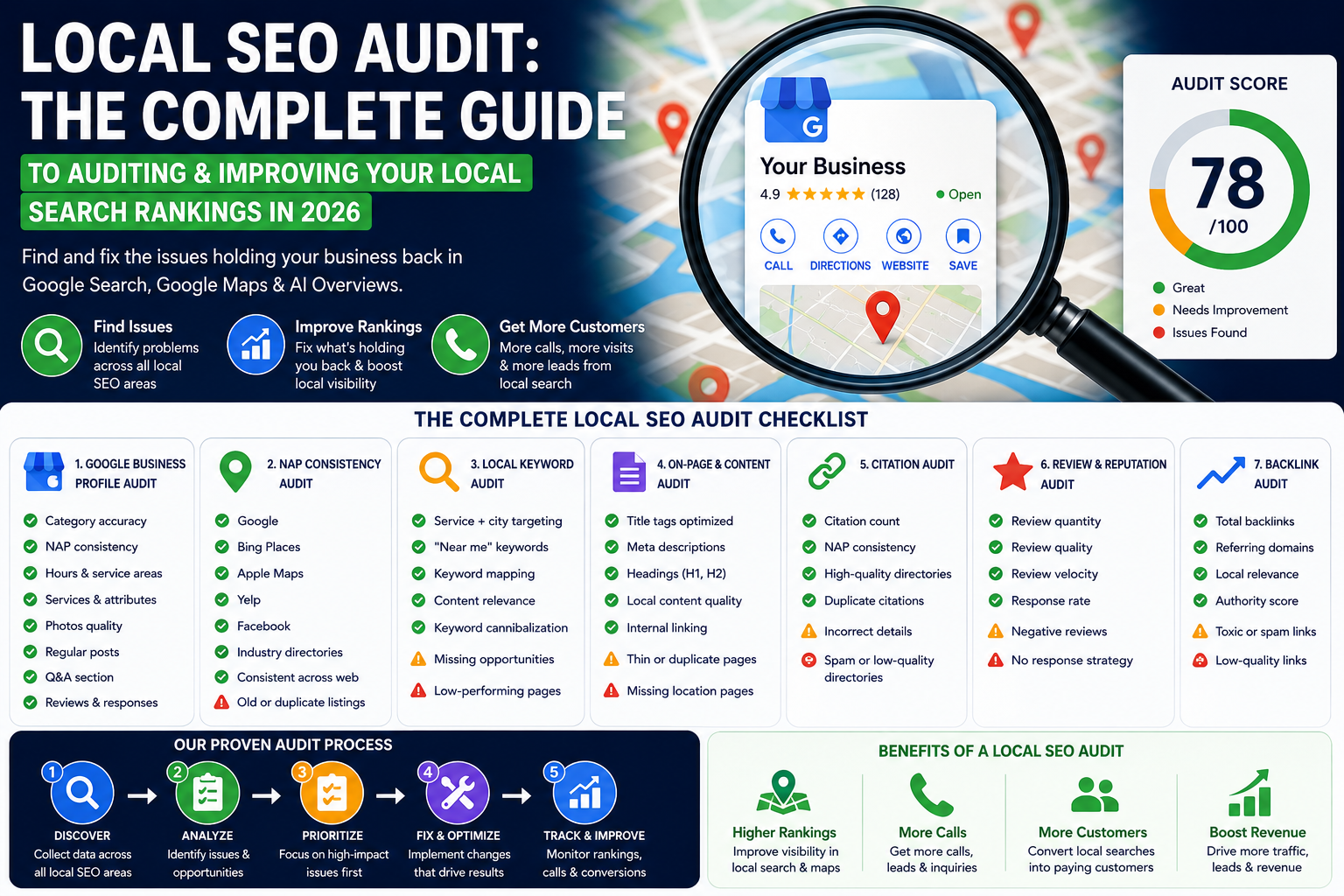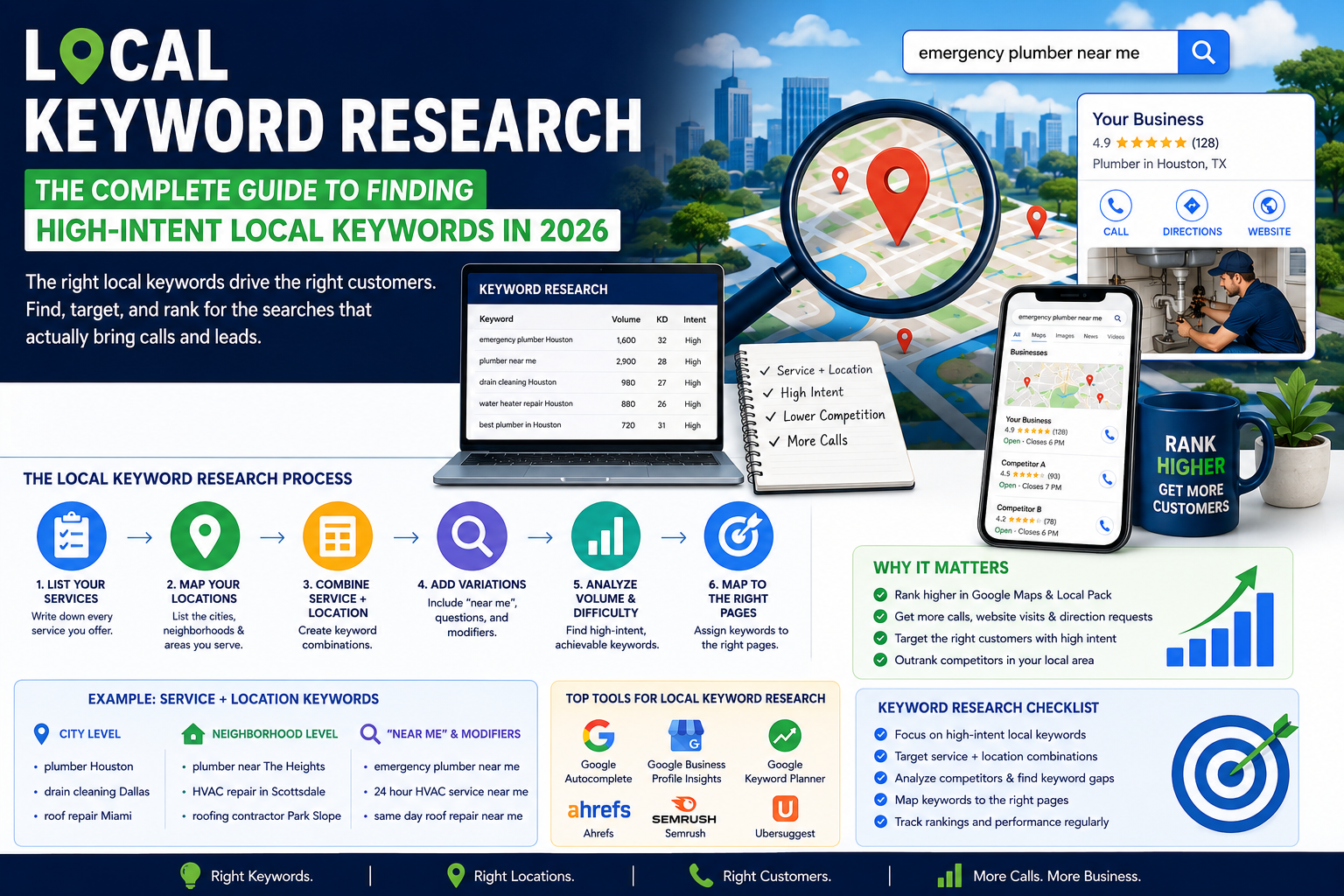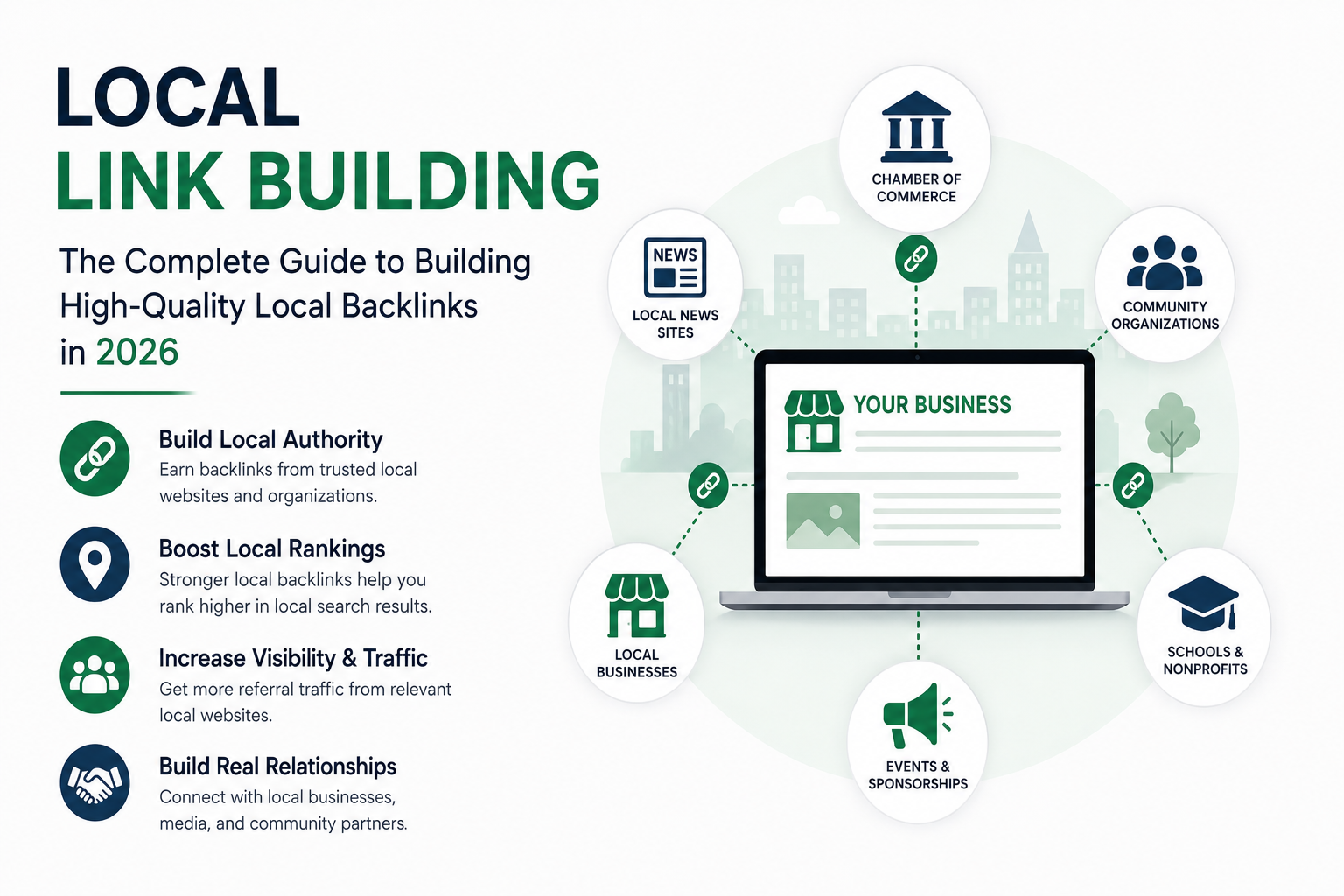
Local Link Building: The Complete Guide to Building High-Quality Local Backlinks in 2026
Most small business owners have heard that backlinks matter for Search Engine Optimization (SEO), but a lot of the advice out there is written for national brands with PR teams and content budgets most local businesses simply don't have. You don't need a viral campaign or a team of outreach specialists to build real local authority. You need a handful of genuinely good local backlinks, earned the right way, from sources that actually mean something in your community.
This guide is about exactly that — local link building for small businesses, without the fluff, the shortcuts, or the tactics that used to work in 2015 and now just get you flagged. If you've been wondering how to get local backlinks that actually move your rankings instead of sitting there doing nothing, this is the full playbook.
What Local Link Building Actually Means
Local link building is the process of earning backlinks from websites that carry local relevance — other businesses, organizations, media outlets, and community sites within or connected to the area you serve. It sits under the broader umbrella of Local SEO, but it deserves its own dedicated strategy, because the way you earn a local backlink is fundamentally different from the way you'd pursue link building for a national or purely organic search play.
A backlink from a national tech blog might carry general authority, but a backlink from your city's chamber of commerce, a local news outlet, or a well-known community organization tells search engines something more specific: that real, local entities recognize and vouch for your business. This is why local link building and general link building, while related, aren't quite the same discipline — one is optimized for broad domain authority, the other for local search ranking specifically.
This matters because your position on the local Search Engine Results Page (SERP) depends heavily on prominence — how well-known and trusted your business appears to be, both to searchers and to the algorithms evaluating you. Backlinks are one of the clearest signals of that trust that search engines can actually measure. A business with a handful of strong, relevant local backlinks tends to outperform a business with dozens of generic, low-quality ones, even if the second business technically has a bigger link count.
Local Backlinks vs. Local Citations: What's the Difference?
This is a common point of confusion, so it's worth clearing up before going further. A citation is a mention of your business name, address, and phone number (NAP) on another website — directories like Yelp, YellowPages, or industry-specific listing sites are the classic example. A citation doesn't necessarily include a clickable link back to your site, though many do.
A backlink, on the other hand, is specifically a hyperlink pointing from another website to yours. It doesn't have to include your NAP information at all — it might just be a mention of your business name linked to your homepage from a blog post, a news article, or a partner's website.
Local citations vs backlinks isn't really an either/or question — you need both, and they serve slightly different purposes within your broader SEO strategy. Citations build consistency and trust signals tied to your business information. Backlinks build authority and pass ranking value more directly, both for local search and, to a lesser extent, for your general organic search visibility. A strong local SEO strategy uses both, but if you're choosing where to focus first, backlinks generally carry more direct ranking weight, while citations are more foundational and easier to build in volume.
Why Most Local Link Building Advice Doesn't Work
Before getting into what actually works, it's worth naming what doesn't, because a lot of businesses waste real time and money on outdated tactics:
- Buying links from link farms or "SEO package" sites. These are often flagged by Google and can do more harm than good to your standing across both local search and general organic search.
- Mass directory submissions with no relevance to your industry. A handful of strong, relevant citations beats a hundred generic ones with zero connection to what you actually do.
- Guest posting purely for the link, with no real value to the host site's audience. Google has gotten increasingly good at recognizing low-effort guest content built solely for link placement.
- Reciprocal link exchanges ("I'll link to you if you link to me") done purely for SEO purposes rather than genuine partnership, which Google's guidelines specifically discourage as a manipulative pattern.
The businesses that build real local SEO link building success in 2026 are doing something more deliberate: creating genuine reasons for other local sites to link to them, rather than asking for links that have no real basis behind them.
Strategy 1: Get Listed With Your Local Chamber of Commerce and Business Associations
This is one of the simplest, most overlooked local link building strategies. Most Chambers of Commerce, Better Business Bureau chapters, and local business associations offer member directories with a backlink to your website. These sites typically carry solid local authority — often reflected in a healthy domain authority score — and the link is earned through a legitimate membership rather than manipulation.
Beyond the Chamber itself, look for industry-specific local associations — a local contractors' guild, a regional restaurant association, a small business alliance in your metro area. These tend to be underused by competitors, which makes them a relatively easy win for both local search visibility and general link building.
Strategy 2: Sponsor Local Events, Teams, or Nonprofits
Sponsorship is one of the most natural ways to earn a local backlink, because the link comes with a genuine reason behind it rather than a cold outreach request. A youth sports team, a local charity 5k, a community festival, or a nonprofit fundraiser will often list their sponsors on their website with a link back to the sponsor's site.
This works especially well for local business link building because it does double duty — you get real community goodwill and visibility, plus a backlink from a locally relevant, often well-trusted site. It's not free, but it's rarely as expensive as people assume, and the relationship-building value alone often justifies it beyond the SEO benefit.
Strategy 3: Partner With Complementary Local Businesses
Look for local businesses that serve a similar customer base without being direct competitors, and build genuine partnerships. A landscaper and a pool installation company, a wedding venue and a local florist, a moving company and a real estate agent — these kinds of pairings make natural sense for cross-promotion, and cross-promotion often naturally includes a link on each other's website ("Recommended Partners" or "Preferred Vendors" sections are common on service-business websites for exactly this reason).
This is one of the best local backlink strategies precisely because it doesn't feel like link building from the outside — it's a genuine business relationship that happens to include an SEO benefit as a side effect, and it strengthens your local search presence without the risk profile of more aggressive tactics.
Strategy 4: Get Featured in Local News and Media
Local news outlets, community blogs, and regional magazines are consistently strong sources of local backlinks, and they're more accessible than most business owners assume. You don't need a massive PR budget — you need a genuinely newsworthy angle.
A few angles that consistently work:
- Announcing a real milestone — an anniversary, an expansion, a new location.
- Community involvement — organizing or participating in a local event, a charity drive, or a notable local hire.
- Expert commentary — many local reporters are actively looking for local business owners to quote on relevant stories, and building a relationship with a local journalist or two can pay off repeatedly over time.
- A genuinely unique story angle specific to your business or industry, rather than a generic press release that reads like an ad.
Local journalists are often easier to reach than people expect — a well-written, genuinely relevant pitch by email frequently gets a response that a cold outreach email to a national blog never would. And a backlink from a reputable local news domain tends to carry meaningful domain authority relative to the effort involved.
Strategy 5: Create Locally-Focused Content Worth Linking To
This is where local link building for small businesses connects directly to your broader content strategy. Certain types of content naturally attract local backlinks because other local sites find them genuinely useful to reference:
- Local guides and resource pages — "best neighborhoods for first-time homebuyers in [your city]," "a guide to local permits for home renovation projects," or similar resources that other local businesses or bloggers might naturally reference.
- Original local data or surveys — even a small, informal survey of local customers or a simple data breakdown specific to your area can become a source other sites cite.
- Community spotlights — profiling other local businesses, nonprofits, or community figures often earns a link back when those featured parties share the content themselves.
The key with this strategy is patience. Content-based link earning is slower than direct outreach or sponsorship, but it tends to compound — a genuinely useful local resource page can keep earning links for years after it's published, feeding both your local search ranking and your broader organic search performance with no ongoing effort required.
Strategy 6: Build Relationships With Local Bloggers and Influencers
Every city and region has a handful of local bloggers, YouTubers, or social media accounts covering local food, events, home services, or lifestyle content. Building a genuine relationship with a few of these — rather than a one-off transactional ask — often leads to organic mentions and links over time, especially if you're able to offer something of real value in return: a product sample, a service demonstration, or simply being a genuinely useful source for their content.
This tends to work best when approached as relationship-building rather than a link request. A cold email that opens with "will you link to my site" rarely lands well. An email that opens with genuine interest in their content and an offer that benefits them directly tends to perform far better — and the link, when it happens, feels earned rather than transactional.
Strategy 7: Use Local PR and Award Opportunities
Local "best of" awards — best local business, best contractor, best restaurant in a regional magazine's annual roundup — are more accessible than people assume, and they typically come with a backlink from a genuinely authoritative local publication. Many of these are decided by public voting, nomination, or straightforward application rather than requiring major PR budgets. Watching for these opportunities throughout the year and applying or encouraging your customers to nominate you is a low-cost way to earn some of the strongest local backlinks available.
How to Prioritize: What's the Best Local Link Building Strategy for a Small Business With Limited Time?
If you can only focus on two or three of the strategies above right now, prioritize based on effort versus payoff:
- Chamber of commerce and association memberships — low effort, quick to set up, reliably solid local authority.
- Partnerships with complementary local businesses — moderate effort, but often leads to an ongoing relationship rather than a one-time link.
- Local media and PR opportunities — higher effort, but the highest authority payoff, and worth pursuing consistently rather than as a one-off push.
Sponsorships and content-based link earning are excellent long-term additions once the above three are in motion, but they typically require more sustained investment before they start compounding.
How to Evaluate Whether a Local Backlink Is Actually Worth Pursuing
Not every local link opportunity is equally valuable. Before investing time or money into a specific link opportunity, ask:
- Is the site genuinely locally relevant, or is it a generic directory with no real local audience behind it?
- Does the site have real traffic and engagement, or is it essentially an abandoned page that happens to still be indexed?
- Is the link earned through a legitimate relationship or contribution, rather than a paid placement disguised as editorial content?
- Would this link exist even if SEO wasn't a consideration at all? If the honest answer is no, it's worth questioning whether the link is worth pursuing, since search engines are increasingly good at recognizing links that exist purely for manipulation rather than genuine relevance.
Anchor Text: The Detail Most Businesses Get Wrong
Anchor text — the clickable, visible words in a hyperlink — plays a bigger role in local link building than most business owners realize, and it's also one of the easiest places to accidentally look manipulative. A natural backlink profile includes a mix of anchor text: your business name, a branded phrase, a general description ("this local plumber," "a great HVAC company in the area"), and occasionally your target keyword itself.
The mistake many businesses make is asking every site that links to them to use the exact same keyword-stuffed anchor text — "best local SEO services" repeated across twenty different backlinks, for example. This pattern is one of the more obvious signals search engines look for when identifying manipulative link building, and it can do more harm to your local search ranking than having no link at all from that source. Let anchor text vary naturally, the same way it would if these links were earned organically rather than requested.
Common Local Link Building Mistakes
A few patterns to avoid:
- Chasing link volume over link relevance. Ten strong, genuinely local backlinks will typically outperform a hundred generic, low-authority ones.
- Ignoring existing relationships. Many businesses have vendors, partners, and community connections that could easily become natural backlink sources, and never think to ask.
- Treating link building as a one-time project rather than an ongoing part of how the business engages with its community.
- Over-optimizing anchor text, as covered above — natural, varied link text looks far more legitimate than repeated exact-match keyword phrases.
- Neglecting to track results. Without checking which backlinks are actually driving referral traffic or correlating with ranking improvements, it's hard to know which strategies are worth doubling down on.
Measuring Whether Your Local Link Building Is Actually Working
It's easy to accumulate a handful of backlinks and assume the work is done. But local link building only pays off if you're tracking whether those links are actually contributing to something — rankings, referral traffic, or leads.
A few things worth checking on a regular basis:
- Referral traffic from each link source, using your website analytics. A backlink that never sends a single visitor may still carry some SEO value, but it's worth knowing which links are pulling their weight versus which ones are essentially invisible.
- Movement on the local SERP for your target keywords in the weeks and months after a new batch of backlinks goes live. This isn't a perfectly clean signal on its own, since rankings shift for many reasons, but consistent movement following consistent link building is a reasonable indicator that the strategy is working.
- Domain authority of the sites linking to you, tracked over time, to make sure you're building relationships with sites that are themselves gaining — not losing — credibility.
- The overall mix of your backlink profile — are you overly reliant on one type of link (directories, for example) with very little from media, partnerships, or community sources? A diverse, natural-looking backlink profile tends to hold up better over time than one concentrated in a single source, and it supports both your local search ranking and your broader organic search performance.
If you're working with an agency or freelancer on local link building services, ask for visibility into exactly which sites are linking to you and why. A vague report showing only a rising link count, with no detail on where those links actually came from or how much domain authority they carry, is a reasonable signal to ask more questions before continuing the engagement.
Local Link Building as an Ongoing Habit, Not a Campaign
The businesses that build the strongest local backlink profiles over time tend to treat it less like a one-time SEO project and more like an ongoing part of how they operate locally — sponsoring the same community event every year, maintaining an active chamber of commerce membership, staying in touch with a couple of local journalists, and continuing to build partnerships with complementary businesses as the business grows.
This approach tends to outperform a short, intense link building push followed by months of inactivity, both because it looks more natural to search engines and because it keeps producing new opportunities on its own — a journalist you helped once may come back for a follow-up story, a partner business may refer real customers alongside the backlink, and a strong chamber relationship can open doors well beyond SEO. Treated this way, local link building stops being a task to check off and becomes a natural byproduct of being genuinely active and connected in your own community — while quietly compounding your local search ranking, your standing on the local SERP, and your broader organic search visibility all at once.