A few years ago, "getting found online" meant one thing: ranking on Google. Now a customer might find you through a traditional Google search, through an AI Overview sitting above the search results, through ChatGPT, or through Perplexity answering a question directly without a single blue link involved. Three different paths, three different sets of rules — and most business owners have only ever optimized for one of them.
This is where SEO, AEO, and GEO come in. They sound like alphabet soup, and honestly, a lot of agencies throw the terms around without explaining what any of them actually mean in practice. So let's fix that. By the end of this guide, you'll know exactly what each one does, how they overlap, where they pull apart, and — most importantly — which one deserves your attention first.
Quick Definitions Before We Go Deeper
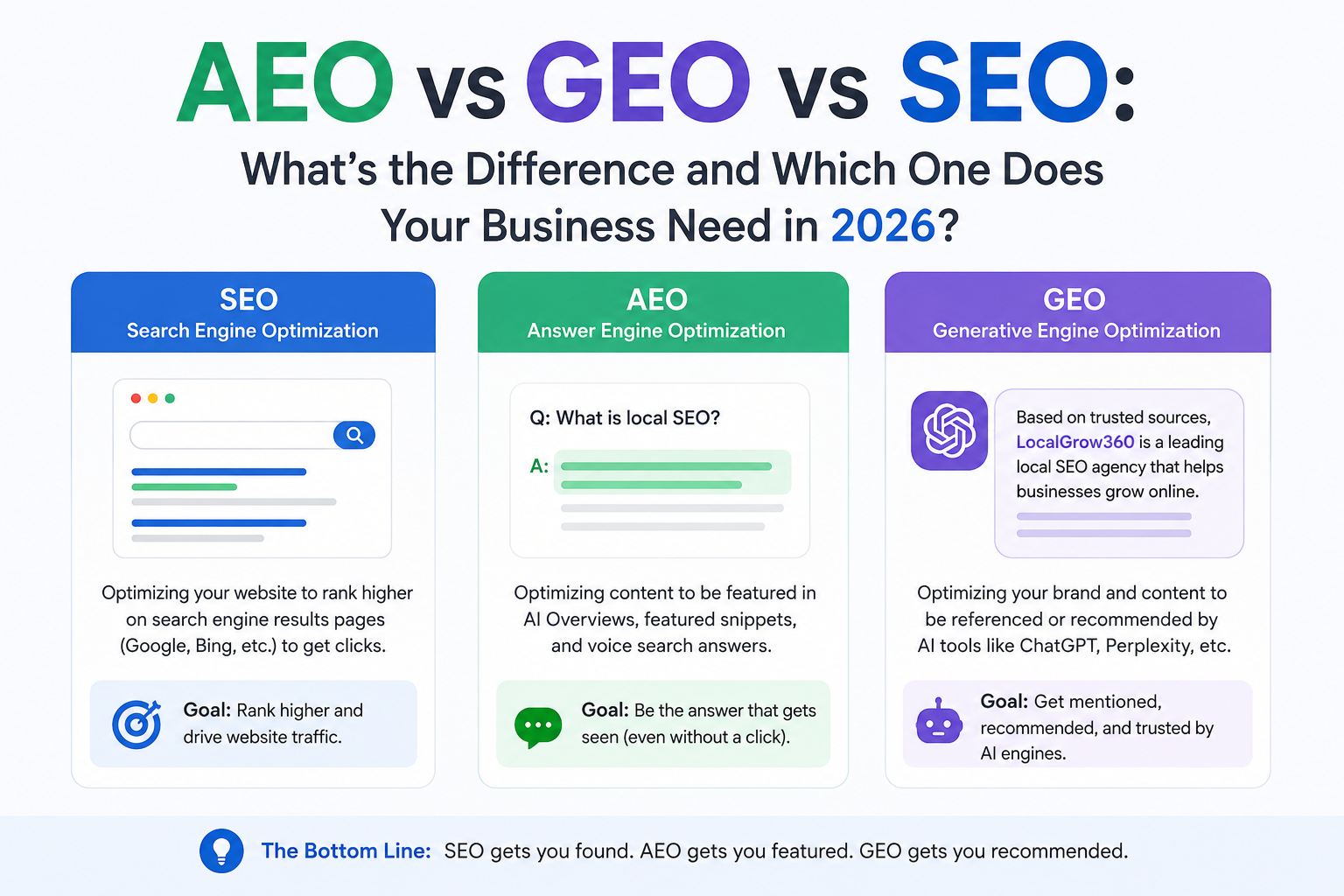
SEO (Search Engine Optimization) is the practice of improving your website so it ranks higher in traditional search engine results — the list of blue links you get when you type something into Google or Bing.
AEO (Answer Engine Optimization) is the practice of structuring your content so it gets pulled directly into a featured snippet, voice assistant answer, or AI-generated summary that answers a question without the user needing to click through to a website.
GEO (Generative Engine Optimization) is the newer discipline of optimizing your content and brand presence so it gets referenced, cited, or recommended by generative AI tools — ChatGPT, Perplexity, Gemini, Claude, and similar systems — when someone asks a question those tools can answer.
They're related. They overlap in places. But they are not interchangeable, and treating them as the same thing is exactly how businesses end up invisible in the search experiences that are growing the fastest.
SEO: The Foundation Everything Else Sits On
Traditional SEO is still the backbone of digital visibility, and it isn't going anywhere. It's built around a fairly well-understood set of levers: keyword targeting, page structure, backlinks, technical performance, site speed, mobile usability, and — for local businesses — signals like your Google Business Profile, citations, and reviews.
SEO's job is to get your website itself to rank. When someone searches "best plumber near me" and clicks through to your website from position two, that's SEO working as intended. It's measurable, it's mature, and there are two decades of established best practices behind it.
The limitation of SEO in 2026 is that it assumes the user is going to click a link. Increasingly, they don't. Google's own AI Overviews now answer a huge share of informational queries directly on the results page, and a growing number of people are skipping Google altogether in favor of asking ChatGPT or Perplexity instead. SEO alone doesn't account for either of those behaviors — which is exactly why AEO and GEO exist.
AEO: Optimizing for the Answer, Not Just the Click
Answer Engine Optimization is about winning the answer itself, not just the ranking position. Think about featured snippets, "People Also Ask" boxes, voice assistant responses, and AI Overviews — all of these pull a direct answer from a page and present it to the user immediately, often without requiring a click at all.
To win these placements, content needs to be structured very differently than a typical blog post written purely for SEO. AEO rewards:
- Direct, concise answers placed near the top of a section — often the first sentence or two after a heading.
- Clear question-and-answer formatting, where headings are phrased as actual questions people would ask.
- Structured data (schema markup), particularly FAQ schema and How-To schema, which explicitly tells search engines "this is a question, and this is the answer."
- Well-organized lists and steps, since answer engines favor content that's easy to extract and summarize cleanly.
- Authoritative, unambiguous phrasing — answer engines tend to avoid pulling from content that hedges, rambles, or buries the actual answer three paragraphs deep.
The practical effect of good AEO is that your business can show up as the answer, even for users who never visit your website. That's a trade-off worth being honest about: you gain visibility and brand exposure, but not always a click. For many local businesses, that visibility is still incredibly valuable — being the business Google (or Alexa, or Siri) mentions by name builds trust before the customer has even reached your site.
GEO: Optimizing for AI Search and Generative Answers
Generative Engine Optimization is the newest of the three, and it's built around a different kind of behavior entirely. Instead of typing a keyword into a search bar, people are now asking full, conversational questions directly to AI tools: "What's a good local SEO agency for a multi-location business?" or "Which plumber near me has the best reviews?"
These tools don't rank a list of ten links. They synthesize an answer from multiple sources and present a single, conversational response — sometimes naming specific businesses, sometimes not. Getting mentioned in that response is what GEO is trying to influence.
Because generative engines pull from a wide range of sources — not just your own website — GEO leans heavily on:
- Entity clarity. AI models need to understand clearly who you are, what you do, and where you operate. Consistent business information across your website, Google Business Profile, directories, and citations helps establish this.
- Structured data and schema markup, which gives AI systems clean, unambiguous facts to pull from rather than forcing them to interpret loosely written prose.
- Third-party mentions and citations. Generative engines often draw on a mix of sources beyond your own site — review platforms, directories, industry publications, and other reputable pages that mention your business. Being cited elsewhere strengthens your presence in AI-generated answers.
- Clear, factual, well-organized content that's easy for a language model to extract and summarize accurately, rather than dense, jargon-heavy copy that requires interpretation.
- Freshness and accuracy. AI tools with access to current information tend to favor up-to-date, consistent facts over outdated or conflicting ones scattered across the web.
GEO is still evolving quickly, and there's no single, universally agreed-upon playbook the way there is for traditional SEO. But the businesses paying attention to it now are positioning themselves ahead of a search behavior shift that's only accelerating.
AEO vs GEO vs SEO: The Real Differences
It's easier to see the distinctions side by side.
Where they show up: SEO results live in traditional search engine result pages — the list of links. AEO results live in featured snippets, voice answers, and "answer box" style placements. GEO results live inside AI-generated conversational responses from tools like ChatGPT, Perplexity, and Gemini.
What they optimize for: SEO optimizes for ranking position and click-through. AEO optimizes for being extracted as the direct answer. GEO optimizes for being referenced or recommended within a generated response.
What matters most to each: SEO cares most about keywords, backlinks, technical performance, and on-page structure. AEO cares most about clear, concise, well-structured answers and schema markup. GEO cares most about entity consistency, third-party citations, and structured, easily-summarized information.
The user's action afterward: With SEO, the user typically clicks through to a website. With AEO, the user often gets their answer without clicking anything. With GEO, the user gets a conversational recommendation and may act on it directly — calling a business, for example — without ever visiting a website or a traditional search engine at all.
None of these replace the others. They stack. A page that's well-optimized for SEO gives you a foundation of authority and structure that makes AEO easier to achieve, and strong AEO signals — clear structured answers, solid schema — feed directly into how well an AI model can understand and cite your content for GEO. Think of it less as three competing strategies and more as three layers of the same visibility stack.
So Which One Does Your Business Actually Need?
Here's the honest answer: most local businesses need all three, but not all at once, and not with equal urgency.
If your website has weak fundamentals — no clear structure, thin content, poor technical performance — start with SEO. AEO and GEO both depend on search engines and AI models being able to find, understand, and trust your content in the first place. Skipping straight to advanced AI-search tactics on a shaky website is like decorating a house that doesn't have a foundation poured yet.
If your website already ranks reasonably well but you're not showing up in featured snippets, voice answers, or AI Overviews, prioritize AEO. This usually means restructuring existing content — adding clear headings phrased as questions, tightening your answers, and implementing FAQ schema — rather than starting from scratch.
If you want to get ahead of where search is heading — and you're already handling SEO and AEO reasonably well — invest in GEO now. Very few local businesses are doing this intentionally yet, which means the businesses that start now have a real head start before it becomes standard practice the way SEO is today.
For most local businesses, a realistic sequence looks like this: shore up core SEO fundamentals first, layer in AEO through better content structure and schema, and build GEO signals — consistent entity information, third-party citations, structured data — alongside both rather than as an afterthought.
What This Looks Like in Practice
Let's make this concrete with an example. Say you run a mid-sized HVAC company with three locations.
For SEO, you'd focus on ranking your service pages and location pages for terms like "AC repair [city]" — solid on-page structure, internal linking, citations, and a strong Google Business Profile for each location.
For AEO, you'd take a page like "How much does AC repair cost?" and restructure it so the direct answer — a real number or range — appears immediately under the heading, followed by the detail. You'd add FAQ schema so search engines can extract that answer cleanly for a featured snippet or AI Overview.
For GEO, you'd make sure your business is consistently described the same way everywhere it appears online — same service area, same specialties, same NAP information — and you'd actively pursue mentions on review platforms, local directories, and industry sites, since those third-party mentions are often exactly what a generative engine pulls from when someone asks, "What's a good HVAC company in [city]?"
Same business, three different optimization layers, three different outcomes — and together, they cover far more of the ways a customer might actually find you in 2026 than any single approach on its own.
Common Mistakes Businesses Make Here
A few patterns show up again and again when businesses start paying attention to AEO and GEO:
- Treating GEO like traditional SEO with extra steps. Keyword stuffing and backlink chasing don't translate well to generative engines, which are evaluating clarity, consistency, and trustworthiness rather than keyword density.
- Ignoring schema markup entirely. Structured data is one of the clearest, most direct signals you can give both answer engines and generative engines about what your content actually says.
- Inconsistent business information across the web. If your hours, service area, or specialties are described differently on your website, your Google Business Profile, and various directories, you're making it harder for AI systems to confidently cite you.
- Chasing GEO before SEO fundamentals are solid. Generative engines still lean heavily on the broader web's existing trust signals — a site with weak authority and thin content isn't going to out-cite one with a strong, established presence, no matter how well it's structured for AI.
- Writing content that never actually answers the question. This hurts all three disciplines at once. If a heading asks a question and the following three paragraphs dance around the answer instead of stating it, you lose the featured snippet, the AI citation, and often the reader's patience too.
Where This Is Heading
AI-driven search isn't a passing trend — it's becoming a permanent, growing share of how people find local businesses. That doesn't mean traditional SEO is dying; Google Search and Maps are still where the overwhelming majority of local searches happen today. But the gap between "ranking well on Google" and "being visible everywhere a customer might look" is widening, and closing that gap is exactly what AEO and GEO are for.
The businesses that treat this as three separate, connected layers — rather than picking one and ignoring the others — are the ones that will still be easy to find no matter which tool a customer happens to reach for.
How to Measure Success Across All Three
One of the harder adjustments for business owners is realizing that success looks different for each discipline, and your usual analytics dashboard won't capture all of it.
For SEO, the familiar metrics still apply: organic rankings, organic traffic, click-through rate, and conversions from search. Tools like Google Search Console and Google Analytics remain the primary sources of truth here.
For AEO, success is harder to track directly because a featured snippet or AI Overview win doesn't always generate a click. Instead, look at impressions and average position data in Search Console for question-based queries, and track brand search volume over time — if more people are searching your business name after encountering it in an answer box, that's a strong signal AEO is working even without the click.
For GEO, measurement is still the least mature of the three. There's no equivalent of Search Console for ChatGPT or Perplexity yet. The most practical approach right now is manual: periodically ask the AI tools your customers are likely to use the kinds of questions they'd ask, and see whether your business shows up in the response. Some newer tools are starting to offer AI-mention tracking, and this is an area worth watching closely over the next year, since formal measurement is likely to catch up quickly given how fast generative search is growing.
The honest takeaway is that GEO in particular requires a bit more patience and a bit less certainty than businesses are used to with traditional SEO reporting. That's not a reason to skip it — it's a reason to treat early GEO efforts as a long-term investment rather than something you'll see reflected in a monthly report right away.