Local Keyword Research: The Complete Guide to Finding High-Intent Local Keywords in 2026
Most local businesses approach keyword research backwards. They start with a tool, type in something generic like "plumber," and walk away with a list of terms that are either too broad to convert or too competitive to realistically rank for. Then they wonder why their local SEO isn't producing calls.
Local keyword research isn't really about finding keywords at all — it's about understanding exactly how a real person in a specific place phrases a specific need, right before they're ready to hire someone. Get that right, and everything downstream — your website, your Google Business Profile, your location pages — has something solid to build on. Get it wrong, and no amount of technical optimization fixes the underlying problem.
This guide walks through how local keyword research actually works in 2026, using the same framework we use before building out a client's local SEO strategy — one built around real local ranking factors, not guesswork.
What Local Keyword Research Actually Means
Local keyword research is the process of identifying the specific search terms people in your service area use when they're looking for what you offer — then organizing those terms by location, intent, and priority so you know exactly what to target and where.
That's different from general SEO keyword research in one important way: geography isn't optional context, it's half the equation. A national SEO campaign might target "roof repair" broadly. A local SEO keyword strategy has to think in terms of Service + City keywords — roof repair in Brooklyn, roof repair near Park Slope, emergency roof repair Kings County. The keyword without the location attached is often close to useless for a business that only serves one metro area.
This is also why local keyword research connects so directly to your Google Business Profile, and to how your listing performs on both Google Search and Google Maps. Your GBP categories, your service area configuration, and your Google Posts all draw from the same underlying keyword research — which is why businesses that treat these as separate projects usually end up with a disconnected, weaker strategy than businesses that build both from the same keyword foundation. This overlap is also what makes Google Maps SEO and Local Pack visibility — the group of three listings shown with a map at the top of local search results — so dependent on the same keyword work that drives your website rankings.
Understanding Local Search Intent
Before you can find the right keywords, you need to understand what kind of intent sits behind them. Not every local search is equally valuable, and treating them all the same is one of the most common reasons local SEO campaigns underperform.
Search intent generally breaks into a few categories:
- Informational intent — someone researching a topic, like "how much does a roof last"
- Navigational intent — someone looking for a specific business by name
- Commercial intent — someone comparing options, like "best roofers in Brooklyn"
- Transactional intent (also called buyer intent or purchase intent) — someone ready to hire, like "emergency roof repair near me"
For local businesses, transactional and commercial intent are where the real value sits. These are the searches closest to becoming a phone call. A local buyer typing "emergency roof repair near me" at 9pm during a storm is a fundamentally different opportunity than someone reading a blog post about roofing materials — and your keyword strategy should weight effort accordingly.
High-intent local keywords tend to share a few traits: they're specific rather than generic, they often include location, and they frequently include urgency or service-specific language ("same-day," "emergency," "24-hour"). Many of the strongest performers are also long-tail keywords — longer, more specific phrases like "same-day emergency AC repair Scottsdale" rather than just "AC repair." These carry lower search volume individually but far higher conversion rates, and typically far less keyword competition than the broad, generic terms every competitor is already chasing. "Near me" keywords fall into this same high-intent bucket, since they signal someone actively looking for a nearby option right now. Learning to spot these patterns in your own market is worth more than any keyword tool, because it tells you which searches represent someone at the point of decision rather than someone still gathering information.
The Service + Location Framework
If there's one mental model that makes local keyword research click, it's this: almost every valuable local keyword is really just a service paired with a location, in one of a few predictable formats. These are sometimes grouped under the umbrella of location-based keywords or city-specific keywords, but they all follow the same basic patterns:
- [Service] + [City] — "Plumber Houston," "Dentist Chicago"
- [Service] + [Neighborhood] — "HVAC Repair near Deep Ellum"
- [Service] near me — "roof repair near me"
- [Service] in [City] — "roof repair in Brooklyn"
- [Business Type] near me — "plumber near me"
- [Business Type] in [City] — "electrician in Dallas"
Once you see this pattern, local keyword research stops feeling like guesswork and starts feeling like a matrix you fill in. Take every core service you offer, and pair it against every geographic layer you actually serve — city, neighborhood, and where relevant, ZIP code or county. A plumbing company serving Houston isn't just targeting "plumber Houston." They're targeting drain cleaning Houston, water heater installation Houston, emergency plumber Houston, and the neighborhood-level versions of each, wherever search volume and competition make that worthwhile.
This same logic extends to product + location and industry + location combinations for businesses where that applies — a flooring company might target "hardwood flooring installation Dallas" alongside more general industry terms tied to their service area.
A real example of this in practice: a multi-location or multi-market business — say, one operating across Phoenix, Scottsdale, Tempe, Chandler, and Mesa in Arizona — shouldn't rely on a single "Arizona" or even "Phoenix" page to capture all of that demand. Each city carries its own local search volume, its own competitive landscape, and often slightly different phrasing. "HVAC repair Scottsdale" and "HVAC repair Mesa" are two separate keyword opportunities, not one keyword with a city name swapped out — and treating them that way is exactly what separates a page that ranks from one that doesn't. The same logic applies at the state level: a business serving all of Georgia still benefits from city-specific pages for Atlanta, Columbus, and Augusta individually, rather than one broad "Georgia" page trying to absorb all three markets' worth of search intent at once.
The Geographic Layers Worth Targeting
Location isn't a single variable — it's several layered ones, and knowing which layer to target for which page is a big part of building an effective local keyword strategy.
City is usually the broadest, highest-volume layer, and the right target for your main service pages. Neighborhood keywords carry less volume individually but convert at a higher rate, since they signal someone specifically looking for a business close to them — this is where local landing pages and location pages earn their keep. ZIP code and postal code targeting is more niche, useful mainly for dense urban markets or businesses that genuinely need that level of precision. County, region, and state level terms matter more for multi-location businesses or service area businesses covering a wide geographic footprint, where a single city page can't reasonably represent the whole territory.
The mistake most businesses make here is picking one layer and ignoring the others — usually just the city — and building a single generic services page that tries to rank for everything at once. Google increasingly rewards specificity, and specificity is exactly what moves local search rankings in a way a generic page can't. A dedicated city page or neighborhood-level service area page, built around genuinely useful local content, will consistently outperform one broad page trying to do too much.
How to Do Local Keyword Research, Step by Step
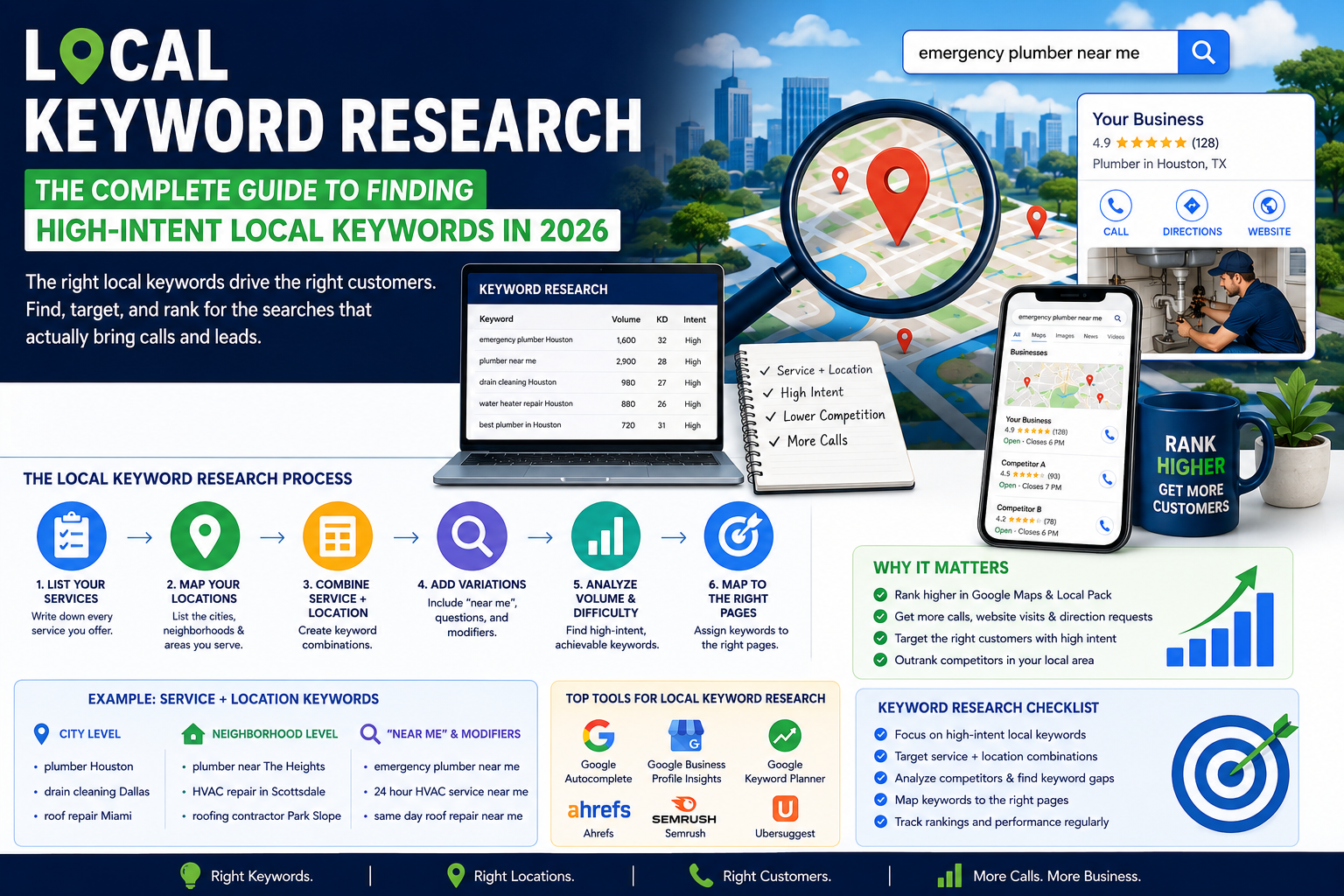
Step 1: List Every Core Service You Offer
Before touching a single tool, write out every real service you provide — not just your broad category. A roofer isn't just "roofing." They're roof repair, roof replacement, roof inspection, storm damage repair, gutter installation, and however many other specific services actually generate revenue. This list becomes one half of your Service + Location matrix.
Step 2: Map Your Actual Service Area
List every city, neighborhood, and if relevant, county your business genuinely serves — not an aspirational list of places you'd like to work, but where you can realistically deliver service today. This becomes the other half of the matrix, and it should match exactly what's configured in your Google Business Profile service areas, since inconsistency between the two undermines both.
Step 3: Combine Services and Locations Systematically
Pair every service against every location layer that makes sense for your business size. This is tedious but it's also where most of the real keyword discovery happens — most local keyword research tools are built around this exact combination logic anyway, so doing it manually first gives you a clearer sense of what to prioritize before a tool ever suggests it to you.
Step 4: Layer in "Near Me" and Question-Based Variations
Alongside the direct service + city combinations, add the "near me" keywords and natural question phrasing real customers use — "who fixes roof leaks near me," "how much does emergency plumbing cost." These often carry strong local search intent and increasingly matter for Google Maps keywords and Google Business Profile keywords too, since GBP posts and Q&A content perform better when they mirror this natural phrasing.
Step 5: Check Local Search Volume and Difficulty
Not every combination in your matrix deserves equal investment. Local keyword search volume tells you how much demand actually exists for a given term in a given area, and local keyword difficulty tells you how hard it'll be to rank for it given current competition. A neighborhood-level term with modest volume but low difficulty is often a better early target than a city-wide term buried under a dozen well-established competitors.
Step 6: Validate Against Google Business Profile Categories
Cross-check your keyword list against your available Business Category options — primary category and secondary category alike. If a high-value keyword doesn't map to any category you can select, or to a service you can list explicitly, that's a signal to reconsider either your GBP setup or how realistic that keyword actually is for your business.
Local Keyword Research Tools
A handful of approaches consistently produce better local keyword research than relying on a single tool in isolation:
- Google's own autocomplete and "related searches" — free, and shows you real, current local search behavior directly from the source
- Google Business Profile Insights — shows the actual search terms people used to find your existing listing, which is about as high-intent local keyword data as you can get
- Dedicated local SEO keyword tools — most major SEO platforms include local-specific keyword and rank-tracking features, useful for local keyword tracking and local keyword rankings over time
- Google Maps search itself — manually searching your core services in your service area, on both desktop and mobile, reveals what Google is actually surfacing right now, competitors included
No single tool captures everything. The businesses that do local keyword research well tend to combine free, direct signals (autocomplete, GBP insights) with a paid tool for volume and difficulty data, rather than relying on either alone.
Keyword Mapping, Clustering, and Avoiding Cannibalization
Once you have a full list, the next job is keyword mapping — deciding exactly which page each keyword or keyword group is meant to rank for. Related terms should be grouped through keyword clustering rather than each getting its own page; "emergency plumber Houston," "24-hour plumber Houston," and "same-day plumber Houston" are close enough in intent that they belong on one strong page, not three thin ones competing with each other.
That competition between your own pages is called keyword cannibalization, and it's one of the more subtle ways a local keyword strategy quietly undermines itself. When two pages on the same site both target near-identical terms, Google often can't decide which one to rank, and both end up performing worse than a single, well-consolidated page would. Careful keyword mapping upfront is the easiest way to avoid this before it becomes a problem worth untangling later.
Beyond the Keyword List: Citations, Backlinks, and Reviews
Keyword research doesn't operate in isolation — it works alongside the broader trust signals that make up your local ranking factors. Local citations (consistent mentions of your business name, address, and phone number across directories) and local backlinks (links from other relevant, credible sites) both reinforce the same geographic and topical relevance your keyword strategy is built around. Google Reviews add another layer, since review content often naturally contains the same service and location language your keyword research surfaces — a customer writing "best emergency roofer in Brooklyn" in a review reinforces exactly the kind of term you're already targeting on the page itself.
None of these replace solid keyword research, but a well-researched keyword strategy paired with weak citations, few backlinks, or a thin review profile still tends to underperform. The keywords tell Google what you're relevant for; the citations, backlinks, and reviews tell Google you're trustworthy enough to actually rank for it.
Local Competitor Keyword Research
Understanding what your competitors are already ranking for is one of the fastest ways to shortcut your own local keyword research. If three competitors are all ranking for "same-day AC repair Dallas" and you're not even targeting that term, that's an immediate, obvious gap.
A proper local competitor analysis looks at a few things together: their competitor keywords and competitor rankings, their competitor Google Business Profile setup — categories, services listed, review volume — and their competitor location pages, if they have them. This is sometimes called SERP analysis or local SERP analysis: literally looking at who's currently ranking for your target terms and reverse-engineering why.
The goal isn't to copy a competitor's strategy wholesale. It's to find the keyword gap — the terms with real local search intent that your competitors haven't prioritized, or the content gap where they're ranking with thin, low-effort pages you could genuinely outperform with something more useful. Local competitor gap analysis, done properly, often surfaces easier ranking opportunities than starting from a completely blank keyword list.
Local Keyword Research by Business Type
The framework above holds across industries, but how you apply it shifts depending on what kind of business you run.
For contractors and home service businesses — plumbers, electricians, HVAC companies, roofers — urgency-driven "near me" and emergency-service keywords tend to carry outsized value relative to their search volume, since they represent customers actively mid-problem.
For service area businesses without a storefront customers visit, neighborhood and city-layer keywords matter more than exact-address proximity, since your Google Business Profile service area settings — not a single pin — determine where you're eligible to show up.
For multi-location businesses and franchises, local keyword research has to happen separately for each location, since search volume, competition, and even the specific phrasing customers use can vary meaningfully between markets. A single national keyword list applied uniformly across every location page is one of the most common reasons multi-location SEO underperforms. A business operating across Miami, Orlando, Jacksonville, and West Palm Beach — all in Florida — will see real differences in competition and volume between those four markets, and a keyword strategy that doesn't account for that ends up underperforming in at least a few of them.
For small businesses with a single storefront — a dentist, a restaurant, a law firm — neighborhood-level and "near me" targeting often matters more than city-wide competition, since customers are frequently choosing based on genuine proximity alongside trust signals like reviews.
Turning Keywords Into Pages
Keyword research that never gets mapped to actual content doesn't do much good. Once you have a prioritized list, the next step is matching each keyword or keyword cluster to the right page type: broad service + city terms typically belong on your main service pages, while neighborhood-specific or highly localized terms usually deserve their own local landing page, city page, or service area page.
This is also where a lot of local SEO goes wrong. Thin, templated location pages — the kind that just swap out a city name across an otherwise identical page — tend to underperform, sometimes worse than having no dedicated page at all, because Google's systems are good at recognizing duplicate, low-effort content. A location page built around real local keyword research should say something genuinely specific to that place: which neighborhoods it covers, any location-specific detail worth mentioning, and ideally, location-specific reviews or proof points.
Common Local Keyword Research Mistakes
A few patterns show up again and again in local keyword research done poorly:
- Targeting only city-wide terms and ignoring neighborhood-level opportunities entirely
- Building keyword lists that don't match what's actually configured in the Google Business Profile service area or category settings
- Chasing high-volume terms while ignoring local keyword difficulty, ending up with a list that's technically accurate but unrealistic to rank for
- Skipping competitor research entirely and missing obvious, low-effort keyword gaps
- Treating keyword research as a one-time task rather than revisiting it as services, locations, or competitors change
- Creating thin location pages that swap a city name into a template instead of genuinely addressing local search intent
Avoiding these alone puts a business ahead of a meaningful share of local competitors making the same mistakes without realizing it.
Conclusion
Local keyword research done well isn't about generating the longest possible list of terms — it's about understanding, specifically, how real people in your actual service area search when they're close to hiring someone. The Service + Location framework, layered against genuine local search intent and checked against what your competitors are already ranking for, gives you a keyword strategy that's grounded in real behavior rather than guesswork.
The businesses that treat this as an ongoing practice — revisiting their keyword list as they expand into new neighborhoods, add new services, or watch competitors shift their own strategy — consistently outperform the ones who did this once, years ago, and haven't touched it since. If you're not sure where your current keyword strategy stands, a good starting point is simply searching your core services from your own service area, on your own phone, and seeing exactly who shows up before you do.