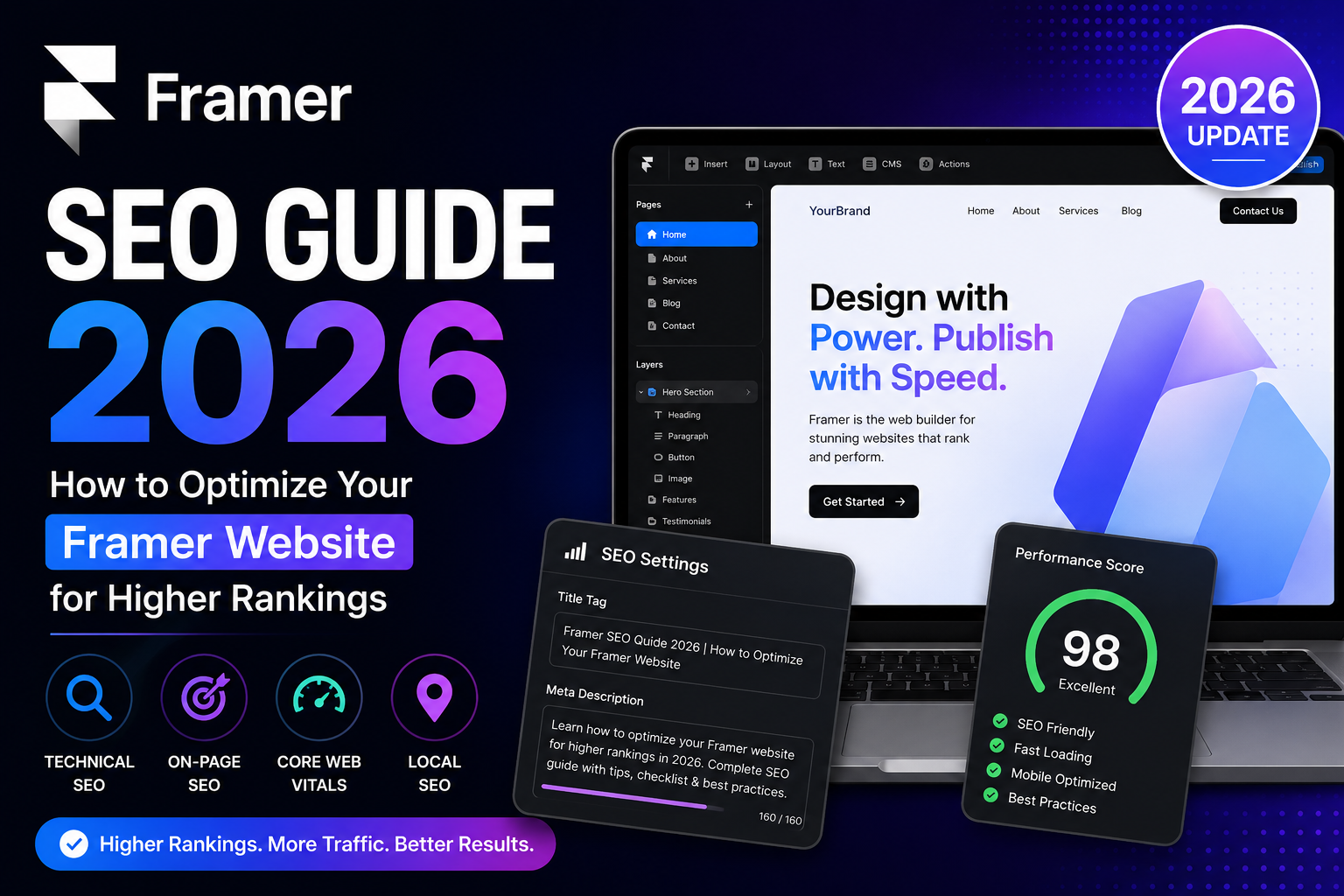
Framer SEO Guide How to Optimize Your Framer Website for Higher Rankings
Launching a beautiful website in Framer is easy. Getting it to rank on Google and appear in AI-powered search results is a different challenge.
Many businesses invest time in creating an attractive Framer website but overlook the SEO fundamentals that help search engines understand, index, and rank their pages. As a result, their websites receive little organic traffic despite having excellent design and user experience.
The good news is that Framer is capable of supporting a strong SEO strategy when configured correctly.
This guide walks you through the complete Framer SEO process—from technical optimization and on-page improvements to AI Search Optimization (GEO), Answer Engine Optimization (AEO), and content strategies that help your website attract qualified traffic and generate more leads.
Whether you're a startup founder, agency owner, freelancer, SaaS company, or local business, you'll learn practical techniques you can implement immediately to improve your rankings.
What Is Framer SEO?
Framer SEO is the process of optimizing a Framer-built website so search engines such as Google, Bing, and AI-powered search platforms can easily crawl, understand, index, and rank its content.
It involves much more than adding keywords to a page. Effective Framer SEO combines technical improvements, content optimization, website structure, page speed, user experience, internal linking, structured data, and authority-building practices.
A well-optimized Framer website helps search engines answer questions like:
What is this page about?
- Which keywords should it rank for?
- Is the content trustworthy?
- Does it provide value to users?
- Is the page fast and mobile-friendly?
- Is it the best result for a user's search?
When these questions are answered clearly, your chances of ranking improve significantly.
Is Framer Good for SEO?
Yes. Framer has evolved into a modern website platform with many built-in SEO capabilities.
It supports essential SEO features such as:
- Custom page titles
- Meta descriptions
- Clean URLs
- XML sitemap generation
- Robots.txt
- Canonical tags
- Fast page loading
- Responsive design
- Image optimization
- Open Graph tags
- Redirect management
These features provide a strong technical foundation. However, they do not automatically improve rankings. SEO success still depends on how well you optimize your website and content.
Think of Framer as a high-performance car. The platform gives you the engine, but you still need the right driver, strategy, and maintenance to win the race.
Why SEO Matters for Framer Websites
Many businesses rely heavily on paid advertising or social media for traffic. While those channels can generate leads, they stop producing results when you stop investing.
SEO works differently.
A well-ranked page can continue attracting qualified visitors for months or even years.
Some key benefits include:
- Consistent Organic Traffic
- People actively searching for your products or services are already interested in what you offer. Ranking for relevant keywords helps bring these visitors to your website without paying for every click.
- Higher Trust
- Users generally trust organic search results more than advertisements. Appearing near the top of Google signals credibility and authority.
- Better User Experience
- SEO encourages improvements such as faster loading speeds, clear navigation, and helpful content, which also increase user satisfaction.
- More Qualified Leads
- Instead of reaching everyone, SEO helps you connect with people who are already looking for your solution.
- Better Visibility in AI Search
- Modern search experiences such as Google AI Overviews, ChatGPT, Gemini, and Perplexity increasingly rely on authoritative, well-structured content. A properly optimized Framer website has a better chance of being referenced in these platforms.
- How Google Understands Your Framer Website
Before your pages can rank, Google follows a simple process:
1. Crawling
Googlebot discovers your pages through internal links, XML sitemaps, backlinks, and submitted URLs.
2. Indexing
Google analyzes your content, headings, metadata, structured data, and overall page quality before deciding whether to include the page in its index.
3. Ranking
When someone searches for a related topic, Google's algorithms evaluate hundreds of ranking factors to determine where your page should appear.
If any of these steps fail—for example, if pages cannot be crawled or indexed—your rankings will suffer regardless of how attractive the website looks.
How AI Search Engines Read Framer Websites
Search is evolving rapidly.
Instead of only showing ten blue links, AI-powered search engines generate complete answers by gathering information from trusted websites.
Platforms like:
- Google AI Overviews
- ChatGPT
- Gemini
- Claude
- Perplexity
look for content that is:
- Well structured
- Factually accurate
- Easy to understand
- Rich in context
- Supported by clear headings
- Organized with semantic relationships
This means writing naturally for humans while organizing information in a way that AI systems can easily interpret.
Adding FAQ sections, comparison tables, concise definitions, and structured data increases your chances of being referenced in AI-generated answers.
Keyword Research for Framer SEO
Keyword research is the foundation of every successful SEO strategy.
Rather than targeting broad terms with intense competition, focus on keywords that match your audience's search intent.
For example:
- Search Query Search Intent
- Framer SEO Learn about SEO in Framer
- Framer SEO Checklist Looking for actionable steps
- Technical SEO for Framer Wants technical guidance
- Framer SEO Services Ready to hire an expert
- How to optimize a Framer website Wants a complete tutorial
Each page on your website should target one primary keyword and several closely related secondary keywords.
Avoid trying to rank one page for dozens of unrelated topics.
Build a Strong Website Structure
Website architecture plays a major role in SEO.
Your navigation should make sense for both users and search engines.
A typical structure might look like this:
Home
→ Services
→ Framer SEO
→ Local SEO
→ Technical SEO
→ SEO Audit
→ Industries
→ Blog
→ About
→ Contact
This hierarchy helps search engines understand how pages relate to one another while making navigation easier for visitors.
Optimize Your URLs
URLs should be short, descriptive, and keyword-focused.
Good example:
example.com/framer-seo-guide
Poor example:
example.com/page?id=54872
Keep URLs:
Short
Readable
Relevant
Free from unnecessary numbers and symbols
Once published, avoid changing URLs unless absolutely necessary.
Optimize Page Titles and Meta Descriptions
Your title tag is often the first thing users see in search results.
A strong title should:
- Include the primary keyword
- Stay under approximately 60 characters
- Clearly describe the page
- Encourage clicks
Example:
Framer SEO Guide: How to Optimize Your Framer Website
Your meta description should summarize the page while encouraging users to visit.
Example:
"Learn proven Framer SEO strategies to improve rankings, increase traffic, and optimize your website for Google and AI search."
Create High-Quality Content
Search engines reward content that solves problems.
Rather than publishing short articles targeting individual keywords, create comprehensive resources that answer every important question about a topic.
Each page should:
Address user intent
Include practical examples
Explain technical concepts clearly
Use visuals where appropriate
Stay updated as SEO evolves
Long-form, well-organized content often performs better because it demonstrates expertise and provides greater value.
Optimize Headings Properly
Use only one H1 heading per page.
Organize the rest of the content using H2 and H3 headings.
For example:
H1: Framer SEO Guide
H2: What Is Framer SEO?
H2: Technical SEO
H3: XML Sitemap
H3: Robots.txt
H2: On-Page SEO
H2: AI SEO
A logical heading structure improves readability and helps search engines understand your content.
Image Optimization
Images improve user engagement but can also slow down your website if not optimized.
Best practices include:
Compress images before uploading.
Use descriptive filenames.
Add meaningful ALT text.
Choose modern image formats like WebP where appropriate.
Avoid unnecessarily large image dimensions.
Instead of naming an image:
IMG12345.jpg
Use:
framer-seo-dashboard.webp
And write ALT text like:
Framer SEO settings dashboard showing page title and meta description configuration."
Proper image optimization improves accessibility, page speed, and image search visibility.